At St. John the Divine, we believe music is a vital part of the church experience.
Let the word of Christ dwell in you richly, teaching and admonishing one another in all wisdom, singing psalms and hymns and spiritual songs, with thankfulness in your hearts to God.
Colossians 3:16
Music at St John the Divine
At St. John’s, we joyfully welcome you to worship God through song, regardless of your musical ability. Whether you sing out boldly or join in quietly, your voice is a valued part of our worship.
Our primary instruments are the organ and our voices. The organ provides a rich musical backdrop, preparing our hearts and minds for prayer while leading us in hymns and psalms throughout the service.
We don’t use a praise band—not because we don’t love music, but because the organ and congregational singing best complement our traditional style of worship.
Our Musical Past: The 1924 Wangerin Organ
In 1928, St. John’s acquired a 1924 Wangerin pipe organ (Opus 421) from the Crystal Theater in Burlington. To accommodate it, the church built an organ loft.
The Wangerin featured two manuals (keyboards) and four sets of pipes (ranks):
- Stopped Flute: 16′ – 2′
- Diapason: 8′ – 4′
- Viol d’Orchestra: 8′ – 4′
- Vox Humana: 8′
- A metal bar harp
The organ featured about 26 stop keys, including a tremolo stop.
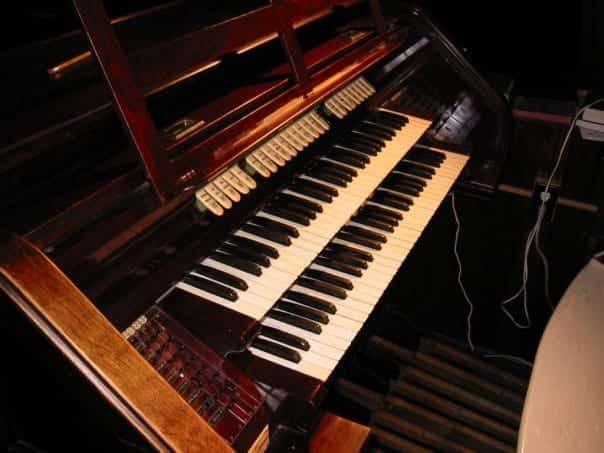
Due to its size and the amount of unification, the organ lacked couplers.
The organ was in a theater-organ style, with the solo (great) manual positioned on top where a traditional swell division would be, while the lower manual served as the accompaniment division.
The key difference between the two keyboards was that the solo manual included a 16′ flute and a 2 2/3′ stop, which the accompaniment manual lacked.
The Wangerin organ served St. John’s faithfully for many years, but its limitations became clear over time. The organ was dependable, but as the congregation’s musical needs evolved, the church wanted something more.
By the early 2000s, the church was considering expanding the organ using its vintage pipework.
However, after much discussion, some committee members involved with the organ felt that the process was taking too long and wished to explore a different direction. As a result, we acquired our current Allen Organ, which is digital and pipe-less.
Our current organ
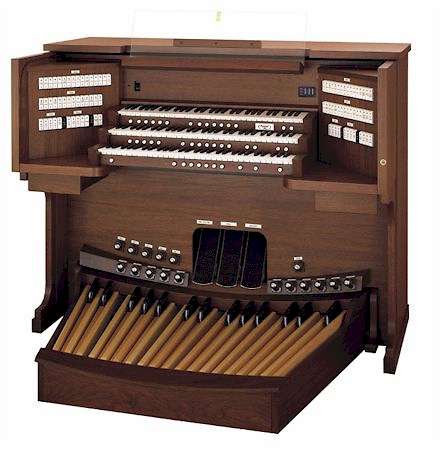
In 2004, St. John’s acquired a new Allen AP-40 organ to supplement the Wangerin. However, we never integrated the Wangerin into the instrument because of a misunderstanding, financial constraints, and time constraints.
We removed the organ, and parts of it live on in other organs. Fortunately, Allen alone more than meets our musical needs, and then some!
Our Allen Organ enriches our worship with a beautiful, versatile range of voices. From soft, lush tones to bold, fanfare-style trumpets, this instrument brings depth and expression to our music.
With the Allen, St. John the Divine enjoys a wider variety of worship music, from traditional hymns to reflective pieces featuring clarinet and flute stops, as well as vibrant, joyful melodies led by the grand trumpet.
Our current organist
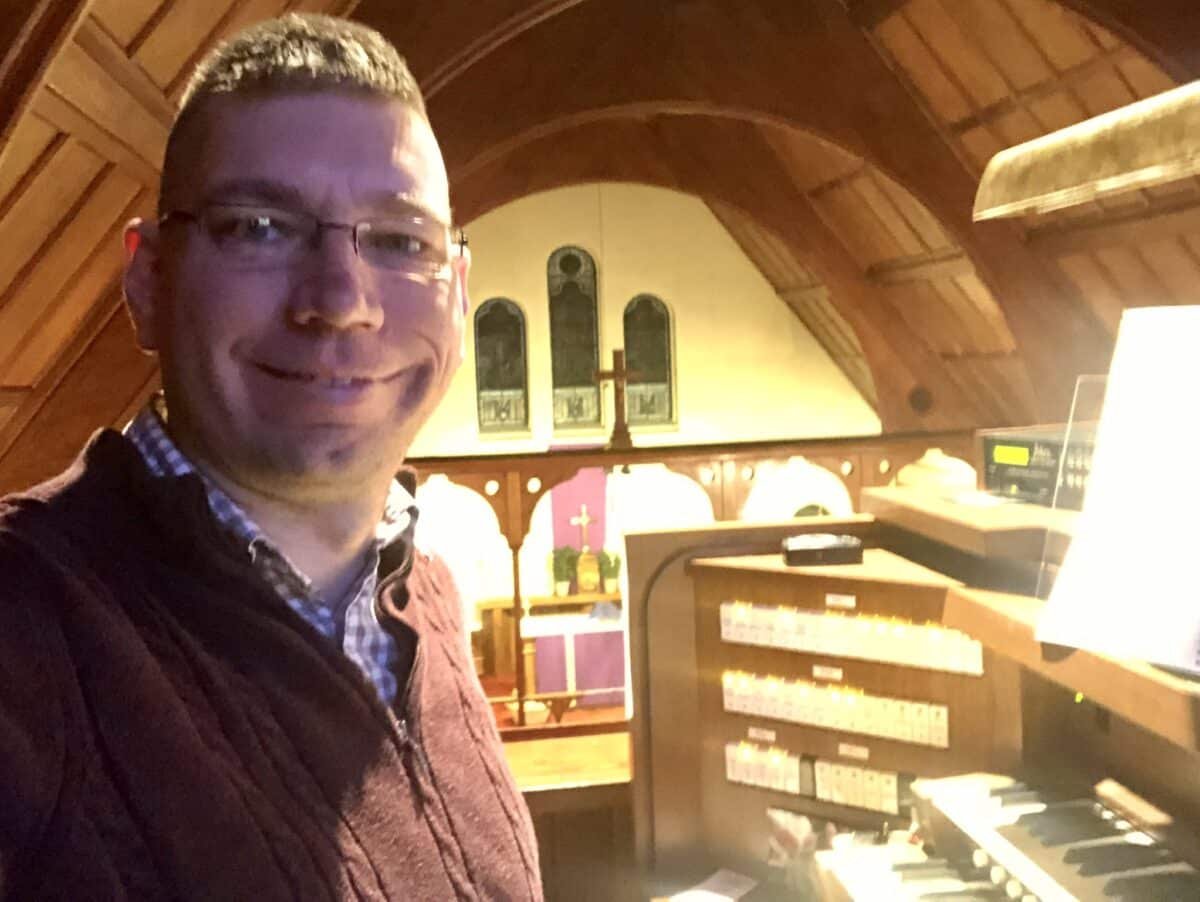
Kevin P. Monteith has been the organist at St. John the Divine Episcopal Church since 1995. Initially self-taught, he later studied organ at the University of Wisconsin-Milwaukee with Jeffrey Peterson, Jim Burmeister, and Martha Stiehl. Additionally, he attended Master Classes with Charles Callahan, John Scott, and others.
Kevin brings more than hymns to our worship; he loves showing the organ’s full range.
Whether improvising during services or accompanying early silent films, he brings creativity and joy to his playing. As he likes to say, he’s sometimes a “frustrated theatre organist who just happens to play in church.”
Besides music, he enjoys traveling and spending time with his family. He is the proud uncle of two nieces and a nephew, and he loves traveling, especially by train. He is the Kev of Travel with Kev!
2004 AP-40 Allen’s Stop List
Walt Strony voiced our organ, using the tonal concept of an American organ with a slight English accent, nodding to the roots of our denomination.
Dean Rosko of Allen Organs of Wisconsin maintains our organ.
Here are the various tonal options for our Allen organ.
Great
• 16 Violone
• 8 Diapason
• 8 Flûte Harmonique
• 8 Gamba
• 4 Octave
• 4 Spitzflöte
• 2 Fifteenth
• Mixture IV
• 16 Posaune
• 8 Tromba
• Tremulant
• Chimes
• French Voicing Gt-Pd
• Gt-Pd Unenclosed
• 16 Swell To Great
• 8 Swell To Great
• 4 Swell To Great
• 8 Choir To Great
Pedal
• 32 Contra Violone
• 16 Diapason
• 16 Bourdon
• 16 Bourdon doux (Sw)
• 16 Violone (Gt)
• 8 Octave
• 8 Gedackt
• 4 Choralbass
• Mixture IV
• 32 Contra Posaune
• 16 Posaune
• 16 Contre Trompette (Sw)
• 8 Tromba
• 4 Clarion
• 8 Great To Pedal
• 8 Swell To Pedal
• 4 Swell To Pedal
• 8 Choir To Pedal
Choir
• 16 Erzähler
• 8 English Diapason
• 8 Melodia
• 8 Erzähler
• 8 Erzähler Celeste
• 4 Prinzipal
• 4 Flute
• 4 Erzähler Celeste II
• 2 Waldflöte
• Cymbale III
• 8 Trompeta Real
• 8 Krummhorn
• Tremulant
• Trompeta Real Unenclosed
• 16 Swell To Choir
• 8 Swell To Choir
• 4 Swell To Choir
• Choir Unison Off
Swell
• 16 Bourdon doux
• 8 Rohr Bourdon
• 8 Salicional
• 8 Voix Celeste
• 4 Prestant
• 4 Flûte Traversière
• 2-2/3 Nasard
• 2 Octavin
• 1-3/5 Tierce
• Fourniture IV
• 16 Contre Trompette
• 8 Trompette
• 8 Hautbois
• 8 Clairon
• Tremulant
• Solo Organ Voices On
• 16 Swell To Swell
• Swell Unison Off
• 4 Swell To Swell
• Celesta
• Harpsichord
French Pedal Voices (second voicing)
• 32 Subbass
• 16 Montre
• 16 Flûte
• 8 Montre
• 8 Flûte
• 32 Contra Bombarde
• 16 Bombarde
• 8 Trompette
• 4 Clairon
French Great Voices (second voicing)
• 8 Montre
• 8 Bourdon
• 4 Prestant
• Prog. Harm. Mixture
Solo Swell Voices (second voicing)
• 4 Orch. Flute
• 8 Clarinet
• 8 French Horn
• 8 Cor Anglais
MIDI
• MIDI On Pedal
• MIDI On Swell
• MIDI On Choir
• MIDI On Great
General
• Bass Coupler
• Melody Coupler Ch>Gt
• Gt-Ch Manual Transfer
• Alternate Tuning
• Tremulants Full
• Gt-Pd Mains Off
• Gt-Pd To Antiphonal
• Swell Mains Off
• Swell To Antiphonal
• Choir Mains Off
• Choir To Antiphonal
Many of the “French voices” were actually performed in a slightly Baroque style.
Other Musical Instruments: Our Piano
In addition to the organ, the Stevenson family donated a piano to the church in 2000. We used the piano for many years to lead our 10 a.m. service, but it now serves in a secondary role.